
Warehouse & Logistics · Case Study
Scaling Multi-Client Fulfillment:
-Based Warehouse Operations for a Growing 3PL
A third-party logistics provider running three fulfillment warehouses for fifteen brand clients replaced spreadsheet stock tracking and paper pick lists with
Inventory and Barcode — client-segregated storage, directed picking, and a custom activity-based billing engine.
Inventory
Barcode
Multi-Warehouse
Website/Portal
Purchase
Industry
Warehouse & Logistics / Third-Party Fulfillment
Business Type
3PL operating 3 fulfillment warehouses for around 15 brand clients
ERP
— Inventory, Barcode, Sales, Accounting + custom billing/returns modules
Scope
Receiving + Storage + Picking/Packing + Dispatch + Client Billing
Implementation
Configuration + Custom Development + Integration
Executive Summary
One shared system across three warehouses and fifteen brands
1The Situation
Each of roughly fifteen client accounts ran on its own spreadsheet, receiving was done against paper goods-received notes, pick lists were matched to orders by hand, carriers were chosen by judgment across four or five separate portals, and month-end client billing was compiled manually.
2The Objective
Give a fast-growing 3PL a shared, client-segregated warehouse system across three facilities — without disrupting live operations — ahead of its next growth phase.
3The Approach
Configure multi-warehouse, ownership-based multi-client inventory and barcode-driven receiving and picking, then extend it with a custom billing engine and returns QC workflow, rolled out warehouse by warehouse.
Business Challenges
Six problems a shared warehouse system needed to solve
Multi-Client Inventory Segregation
Stock belonging to fifteen different brands sat across three warehouses without a system-level mechanism to keep it apart, creating real risk of misallocating one client's inventory against another's order.
Inbound Receiving Accuracy
Manual GRNs with no barcode validation meant quantity and SKU discrepancies were often only discovered later, during picking, when they were far more disruptive to resolve.
Carrier Selection & Label Generation
Paper pick lists with no batching or directed picking sequence led to inefficient walking patterns and a recurring rate of wrong-item shipments.
Quality Checkpoints Not Enforced in the Workflow
Choosing among four or five courier accounts manually, and generating labels through separate portals, slowed dispatch during peak periods.
Client Billing Tied to Actual Activity
Storage and handling invoices were built from incomplete manual records rather than system-logged activity, making disputes common.
Inconsistent Returns Quality Control
Without a structured inspection step, some returned items were restocked without any condition check, occasionally resulting in damaged goods reaching a new customer.
Before
Three warehouses, fifteen client accounts, no single system tying it together
01
Per-Client Spreadsheets
01
02
Paper Goods-Received Notes
02
03
Printed Pick Lists
03
04
Manual Courier Portals (×4–5)
04
05
Manual Month-End Billing
05
06
Inconsistent Returns QC
06
Fifteen client accounts, fifteen spreadsheets, and no single system tying any of it together.
Solution A client-segregated
environment built around barcode-directed operations
Inventory
Multi-warehouse, ownership-based segregation
Barcode
Directed receiving & picking
Sales
Client order & channel tagging
Purchase
Operational supplies
Converging into a custom Activity-Based Billing Engine and a Barcode-Driven Returns QC workflow
Multi-Warehouse, Multi-Client Architecture
Multi-level Bills of Materials were configured with the spice-blend recipe modeled as a sub-component BoM feeding into the finished snack product. Work centers were set up for both production lines with defined operations — mixing, roasting or frying, seasoning, and packing — and raw material consumption is now backflushed automatically against the correct lots when a manufacturing order is completed.
Barcode-Driven Inbound Receiving
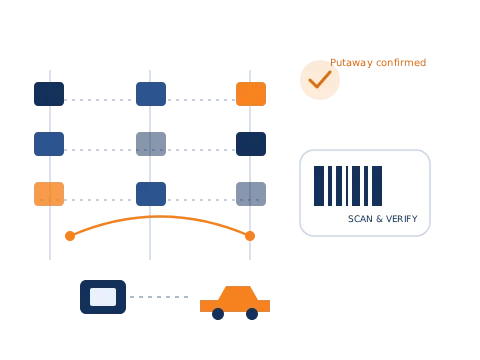
Staff scan the inbound advice or ASN barcode on arrival, then scan each carton or pallet as it’s received; the system checks the scanned SKU and quantity against what was expected and flags any discrepancy immediately. Putaway location is suggested by the system and confirmed with a scan.
Wave & Batch Picking
Orders are batched by carrier cutoff time and warehouse zone, and the barcode app generates a directed pick sequence. At the pack station, contents are scanned and verified against the order before a shipping label is generated.
Standard Reordering for Operational Supplies
Packaging materials and consumables used by the warehouse itself — not client-owned stock — are managed through standard Odoo reordering rules.
Modules Implemented
Where standard
did the heavy lifting
01
WAREHOUSE
Inventory
Multi-warehouse, ownership-based client segregation.
Odoo Implementation
↗
Customization
Where standard
stopped and custom development took over
Vayasoft doesn’t simply install Odoo — it extends it exactly where the business needs something standard
doesn’t offer.
doesn’t offer. 01 Activity-Based Client Billing Engine
-
01 STANDARD
Storage and handling invoices would need to be compiled manually from stock and transaction records each month.
-
02 Vayasoft Customization
A module calculates each client's monthly storage fee from actual average pallet or bin occupancy — computed from historical stock quant data — combined with a per-transaction handling fee based on inbound lines received and orders picked, generating a draft invoice in Accounting for review.
-
03 Business Result
Storage and handling billing disputes with clients dropped noticeably once invoices began reflecting system-recorded activity rather than manual estimates.
02Barcode-Driven Returns QC
-
01 Standard
The standard returns flow restocks items without a mandated condition check.
-
02 VAYASOFT CUSTOMIZATION
Each returned item is scanned and checked against a condition checklist — sellable, damaged, or needs cleaning. Only sellable items are routed back to the pick face; damaged items go to a quarantine location and are automatically linked to a claim record for the brand.
-
03 Business Result
Damaged returns reaching new customers, previously an occasional but persistent problem, have become rare.
Workflow
From dock door to dispatch, in one connected pipeline
Receiving
Putaway
Storage
CENTRAL
Connected ERP
Connected ERP
Picking
Packing
Dispatch
Integrations
Connecting
to the systems already in daily use
Courier APIs
Client Portal
Marketplace / Shopify
WhatsApp / Email Alerts
Label & AWB generated at the pack station, tracking pushed to the client portal automatically
Carrier API Integration
Four major courier partners were integrated via API so the system automatically selects the appropriate service based on each client's shipping rules and destination, generating the label and airway bill directly from the pack station and pushing the tracking number back to the order and client portal.
Client Portal
A custom extension of the standard
portal gives each brand client real-time visibility into stock levels, inbound status, and outbound shipments, plus downloadable monthly storage and handling invoices.
Marketplace Order Sync
Orders from clients' own Shopify and marketplace stores are pulled automatically into
as fulfillment orders tagged by client and sales channel.
Low-Stock Alerts
WhatsApp and email alerts notify client contacts automatically when a critical SKU drops below their defined stock threshold.
Implementation Journey
A phased rollout across three warehouses
-
01
Operational Shadowing
Time spent observing operations across all three warehouses.
-
02
Client SLA & Segregation Workshops
Defined client-specific segregation rules and service-level expectations with account managers.
-
03
Warehouse & Route Architecture Design
Zones, routes and ownership-based segregation designed and configured in staging.
-
04
Custom Development
Billing engine, returns QC workflow and ops dashboard built.
-
05
Data Migration
Opening stock by client established through a full physical count.
-
06
Carrier & Portal Integration
Completed in parallel with the custom development phase.
-
07
Pilot Rollout
One client account in a single warehouse before extending client by client.
-
08
Phased Go-Live & Hypercare
Warehouse by warehouse, with shift-based training and support through the first full month-end billing cycle.
Business Outcomes
What changed after go-live
3% → <0.5%
Mis-pick rate, order lines
~3%
Fewer distributor complaints about product consistency
Same-Day+ → <2 Hours
Average dock-to-stock time from truck arrival to putaway completion.
THE OPERATIONAL DIFFERENCE
Fewer Disputes
Storage & handling billing disputes dropped once invoices reflected system-recorded activity.
Rare, Not Recurring
Damaged returns reaching new customers have become rare since barcode-driven QC was introduced.
Fewer Status Calls
Client calls and emails asking for basic stock or shipment status dropped substantially with portal visibility.
Before vs After
Side by side
01
Old Process
02
New Process
- BEFORE
- TRANSFORM
- AFTER
Per-client spreadsheets with no shared system
01
Ownership-based multi-client inventory in one
instance
Paper GRNs with no barcode validation
02
Barcode-driven receiving with instant discrepancy flags
Printed pick lists matched by hand
03
Directed wave/batch picking via barcode app
Manual carrier choice across 4–5 portals
04
Automated carrier selection with one-click label/AWB generation
Manual month-end billing from incomplete records
05
Draft invoices generated from system-logged storage & handling activity
Technology /
Stack
Stack Everything that went into this build
-
01
Modules
Inventory
Barcode
Sales
Purchase
Accounting & Invoicing
Website/Portal
Documents
Spreadsheet Dashboards
-
02 Custom Development
- Activity-Based Billing Engine
- Barcode Returns QC Workflow
- Cross-Warehouse Ops Dashboard
-
03 Integrations
Carrier APIs
Client Portal
Marketplace Order Sync
WhatsApp/Email Alerts
-
04 Automation & Reporting
- Ownership-Based Stock Segregation
- Directed Putaway
- Wave/Batch Picking
Looking to implement
for your warehouse or logistics operation?
Whether you run one warehouse or ten client accounts across three, we’ll map how stock actually moves — then configure and customize
around it.
around it.