Food Industry · Case Study

From Manual Batches to Traceable Production: An Odoo ERP for a Regional Food Manufacturer

A regional manufacturer of packaged snacks and spice blends replaced spreadsheet recipes, paper QC checklists, and a standalone billing tool with Odoo Manufacturing and Quality — bringing recipe control, batch traceability, and dispatch discipline into one system spanning purchase, production, and sales.
Manufacturing
Quality
Inventory
Purchase
Website/eCommerce

Industry

Food Manufacturing & Distribution

Business Type

Regional packaged snacks & spice blend manufacturer (2 production lines + seasonal co-packer)

ERP

Odoo — Manufacturing, Quality, Inventory, Sales + custom traceability module

Scope

Purchase + Manufacturing + Quality + Inventory + Sales/Distribution

Implementation

Configuration + Custom Development + Integration

Executive Summary

One operational backbone from recipe to dispatch

1The Situation

Recipes lived in supervisor spreadsheets with formulation drift between shifts, raw material purchasing wasn't tied to the production plan, batch numbers were hand-written on labels, and quality checks were recorded on paper without gating dispatch.

2The Objective

Bring recipe control, batch traceability, and quality gating into one system spanning purchase through delivery — without slowing down two production lines during festive-season demand spikes.

3The Approach

Configure Odoo Manufacturing with multi-level Bills of Materials and in-line quality checkpoints, then extend it with a custom lot genealogy report and a production-linked purchasing automation, rolled out line by line.

Business Challenges

Six problems a shared system needed to solve

Recipe & BoM Standardization

Formulation drift between shifts and supervisors meant product consistency depended on who was running the line that day, with no version-controlled reference recipe.

Procurement Disconnected From the Production Plan

Raw material purchasing, especially for seasonal spices, was not tied to confirmed production runs, leading to both overstock write-offs and last-minute shortages.

Batch Traceability From Raw Material to Finished Goods

Manual batch numbering meant that tracing which raw material lots ended up in which finished batches and shipments required a paper search rather than a system query.

Quality Checkpoints Not Enforced in the Workflow

Moisture, weight, and taste-panel checks were recorded after the fact rather than gating whether a batch could move to the finished goods warehouse.

Expiry-Based Dispatch Discipline

Without a systematic FEFO process, older finished goods stock sometimes shipped after newer stock, contributing to distributor returns tied to short shelf life on arrival.

Disconnected Billing & Returns Handling

A standalone billing tool with no stock linkage made monthly reconciliation slow, and distributor returns were processed without any structured reason code.

Before Odoo

Recipes, purchasing and quality — each running on its own track

01

Supervisor Spreadsheet Recipes

01
02

Instinct-Based Purchasin

02
03

Hand-Written Batch Labels

03
04

Paper QC Checklists

04
05

Standalone Billing Tool

05
06

Inconsistent Returns Handling

06

Recipes, purchasing, and quality lived in three different supervisors' heads — and none of it was connected to what accounts was invoicing.

Odoo Solution

A production-aware Odoo environment built around recipes and lots

Purchase

Seasonal ingredient planning

Manufacturing

Multi-level BoM & work centers

Quality

Checkpoints & non-conformance

Inventory

Lots, expiry, FEFO

Converging into a custom Lot Genealogy Traceability Report and an automated Production-Linked Purchasing action
Manufacturing & Recipe Control
Multi-level Bills of Materials were configured with the spice-blend recipe modeled as a sub-component BoM feeding into the finished snack product. Work centers were set up for both production lines with defined operations — mixing, roasting or frying, seasoning, and packing — and raw material consumption is now backflushed automatically against the correct lots when a manufacturing order is completed.
Quality Control Points were configured at two stages: moisture percentage and pack weight are logged when production is registered, and a taste-panel pass/fail check is required before a batch can move to the finished goods location. A failed check routes the batch to rework or scrap instead of allowing it to proceed.
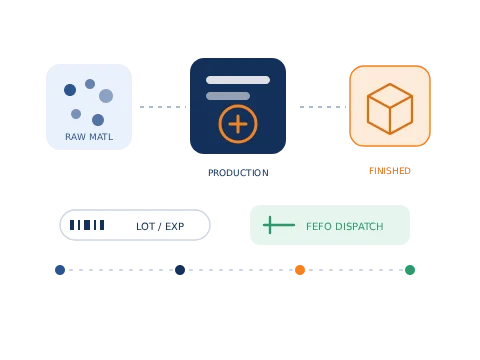
Raw materials and finished goods are tracked with lot numbers and expiration dates. Putaway rules direct temperature-sensitive raw spices to a designated storage location on receipt, and a FEFO removal strategy on the finished goods route ensures the oldest available stock is picked first.
Distributor and modern trade pricelists were configured with case- and carton-level unit-of-measure conversions, minimum order quantities, and scheme-based discounts. Returns are processed against defined reason codes that feed a returns dashboard the sales team reviews monthly.
Modules Implemented

Where standard Odoo did the heavy lifting

01
CORE OPERATIONS

Manufacturing (MRP)

Multi-level BoMs, work centers & routings.

Odoo Implementation
Customization

Six problems a shared system needed to solve

Vayasoft doesn’t simply install Odoo — it extends it exactly where the business needs something standard Odoo doesn’t offer.

01 Lot Genealogy & Traceability Report

Basic lot tracking

Odoo tracks lot numbers on individual stock moves.

Complete genealogy tracking

A "where used / where from" report traces backward from any finished goods lot to the exact raw material lots and supplier batches involved, and forward from any raw material lot to every finished batch and shipment it touched.

Traceability in minutes

Recall-ready traceability now takes minutes instead of a multi-day paper search.

Faster & smarter

02Production-Linked Purchasing & QC Alerts

Basic purchasing rules

Purchase reordering rules react to current stock levels only.

Production-aware automation

A scheduled action cross-checks confirmed sales orders and safety stock against ingredient availability and vendor lead times, generating draft purchase requests ahead of scheduled runs. A second automation sends an immediate WhatsApp/email alert to the plant head when a batch fails its moisture or taste-panel check.

Fewer production surprises

Near-expiry raw material write-offs fell by an estimated 25%, and non-conforming batches are now caught before packing rather than after dispatch.

25% estimated reduction
Workflow

From purchase to delivery, in one connected pipeline

Purchase
Delivery
Expiry
CENTRAL Odoo Connected ERP
Raw Material
Manufacturing
Batch
Quality
Integrations

Connecting Odoo to the systems already in daily use

eCommerce Store
Payment Gateway
Courier API
Label Printers
Shared stock across channels, printed lot/expiry barcode labels, tracking numbers pushed back automatically

eCommerce Channel

The direct-to-consumer online store was connected to the same Odoo inventory used by the wholesale channels, so stock is shared and the risk of overselling online is eliminated.

Payment Gateway

Supports online orders placed directly through the D2C store.

Courier Integration

Books shipments and pushes tracking numbers back onto the corresponding sales order automatically.

Label Printer Integration

Generates barcode labels carrying lot number and expiry directly from the manufacturing order at the packing stations, replacing hand-written labels.

Implementation Journey

A phased rollout across two production lines

Shop-Floor Process Mapping

Observed both production lines before mapping requirements.

Recipe Standardization Workshop

Consolidated the various BoM versions into one reference standard with production supervisors.

Architecture Design

Work centers, routings and quality checkpoints planned up front.

Configuration

Manufacturing, Quality and Inventory configured to match the two lines.

Custom Development

Lot genealogy report and production-linked purchasing action built and tested.

Data Migration & Integration

Ingredient/vendor masters migrated alongside label printer, courier and payment gateway integration.

UAT

Included a simulated recall exercise to confirm the traceability report performed as intended.

Phased Go-Live & Hypercare

Spice-blending line first, then the snacks line two weeks later, with support through a full festive-season production cycle.

Business Outcomes

What changed after go-live

25%

Reduction in near-expiry raw material write-offs

30%

Fewer distributor complaints about product consistency

20%

Fewer repeat near-expiry return incidents from distributors
THE OPERATIONAL DIFFERENCE

Week About a Day

Reduction in near-expiry raw material write-offs

QC Before Packing

Non-conforming batches are now caught before packing rather than after dispatch.

Minutes, Not Days

Any finished goods lot can now be traced back to its raw material batches within minutes.
Before vs After

Side by side

01 Old Process
02 New Process

Recipes as shift-specific spreadsheets

01

Version-controlled multi-level BoMs in Manufacturing

Purchasing driven by supervisor instinct

02

Production-linked automated purchase requests

Hand-written batch labels, no traceability

03

Lot-tracked batches with full genealogy reporting

Paper QC checklists reviewed only when a problem was suspected

04

Quality checkpoints gating movement to finished goods

Standalone billing tool disconnected from stock

05

Integrated Sales/Inventory/Accounting with reason-coded returns

Technology / Odoo Stack

Everything that went into this build

Manufacturing (MRP)
Quality
Inventory
Purchase
Sales
Accounting
Barcode
Website/
eCommerce
Documents
Spreadsheet Dashboards
eCommerce
Payment Gateway
Courier API
Label Printers

Looking to implement Odoo for your food business?

From recipe to dispatch, we’ll map how your production actually runs — then configure and customize Odoo around it.